
By Inej Travel | Weekend Tours | Updated Nov 2026 | 18 min read
TL;DR: Quick Answer
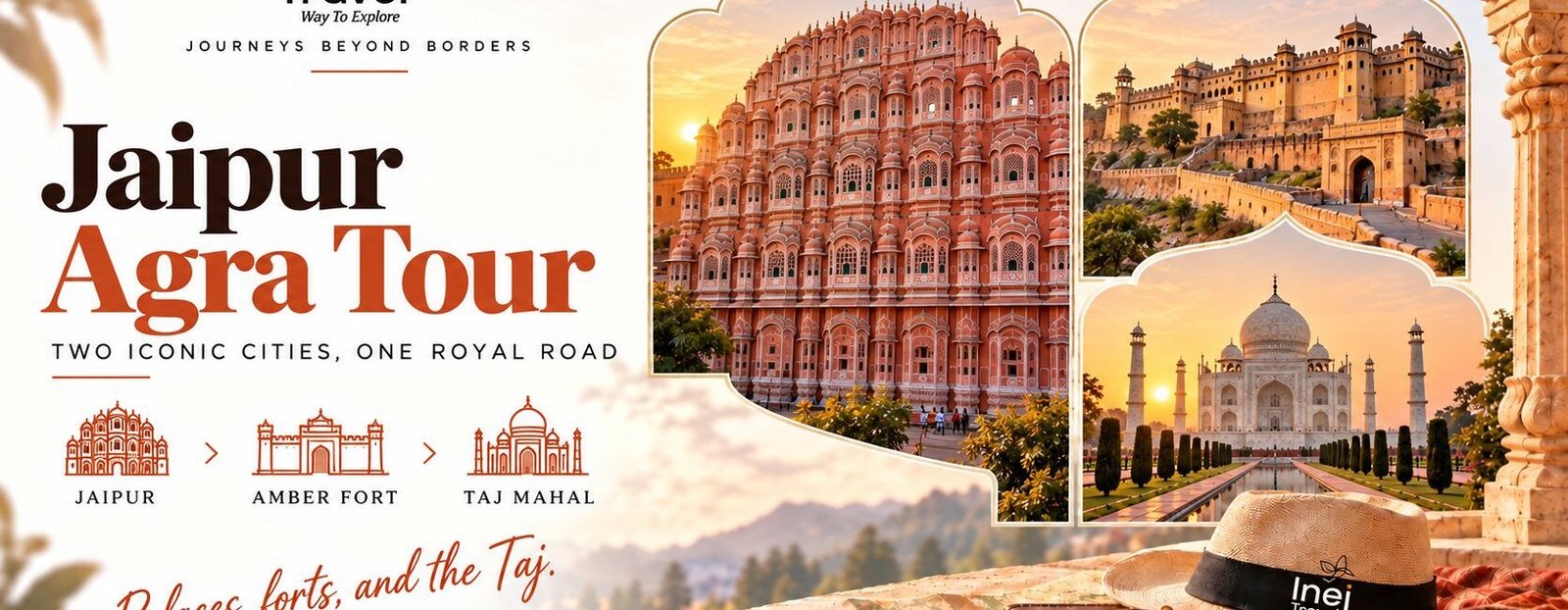
A Jaipur Agra tour combines two of North India’s most visited cities in one short trip: Agra, home of the Taj Mahal and Agra Fort, and Jaipur, the Pink City of Rajasthan with Amber Fort, the City Palace, Jantar Mantar and Hawa Mahal. The two cities sit roughly 270 km apart by the highway route, and the classic route between them passes Fatehpur Sikri, the abandoned Mughal capital that is itself a UNESCO World Heritage Site. Most travellers need at least two full days for this combination, and three days is more comfortable. You can start from Delhi, which is about 210 km from Agra and about 270 km from Jaipur. Inej Travel runs both legs as private car tours with a chauffeur and licensed guide, so the combination is easy to arrange as one plan. The single most important planning fact: the Taj Mahal is closed to visitors every Friday, so sequence your days around that.
Why combine Jaipur and Agra in one trip
Delhi, Agra and Jaipur form the famous Golden Triangle, and many first-time visitors do all three. But not everyone has four or five days, and not everyone wants a city tour of Delhi. If your time or interest is limited, the two-city combination of Agra and Jaipur is the natural alternative. Agra gives you the Taj Mahal, one of the most recognised buildings in the world, plus the red sandstone Agra Fort. Jaipur gives you a very different side of India: Rajput forts on hilltops, a planned 18th-century old city painted terracotta pink, observatories, bazaars and royal palaces.
Doing them together also makes logistical sense. Agra and Jaipur are connected by a direct highway, and the drive between them takes around five hours in normal conditions. Inej Travel’s own Golden Triangle itineraries use this same road leg, with a stop at Fatehpur Sikri on the way. In other words, the Jaipur Agra tour is not a compromise version of the Golden Triangle. It is the two strongest destinations of the triangle, linked by one of the most interesting road journeys in North India.
This guide covers the route, the realistic itineraries for two and three days, what to see in each city, the best order to visit, the best season, and the practical details that matter, including the Taj Mahal’s Friday closure. Package facts in this guide, such as distances, timings and inclusions, come from Inej Travel’s own tour pages, which are linked throughout.
The route at a glance: Delhi, Agra, Jaipur
Most Jaipur Agra tours start and end in Delhi, because Delhi has the region’s main international airport and the best train and road connections. The three points form a triangle:
- Delhi to Agra: about 210 km, roughly four hours by road via the Yamuna Expressway, as listed on Inej Travel’s Delhi and Agra tour page.
- Agra to Jaipur: about 270 km, roughly five hours by road, with Fatehpur Sikri en route, as listed on Inej Travel’s 5-day Golden Triangle itinerary.
- Jaipur to Delhi: about 270 km, roughly five to six hours by road, as listed on the same itinerary.
All three legs are comfortable highway drives in a private air-conditioned car. Train options also exist on the Delhi to Agra and Jaipur to Delhi legs, including fast morning trains, but for the Agra to Jaipur leg a car is by far the most practical choice, because it lets you stop at Fatehpur Sikri and, if you wish, at the Chand Baori stepwell in Abhaneri, a small detour off the highway.
The classic road leg: Agra to Jaipur via Fatehpur Sikri
The drive between Agra and Jaipur is not just a transfer. About 40 km outside Agra sits Fatehpur Sikri, the red sandstone capital built by the Mughal emperor Akbar in the 16th century and abandoned within decades, most likely because of water scarcity. It is a UNESCO World Heritage Site, and Inej Travel’s Golden Triangle itinerary includes it as a stop on the Agra to Jaipur drive. The main sights inside are the Buland Darwaza, one of the tallest gateways in the world, the Jama Masjid courtyard, the tomb of the Sufi saint Salim Chishti, and the palace complex with the Panch Mahal.
Plan on one to two hours at Fatehpur Sikri with a guide. After the stop, the road continues west into Rajasthan. The landscape changes visibly: the flat Gangetic plain gives way to the drier, scrubby country of eastern Rajasthan, and by late afternoon you reach Jaipur. With a 9 AM checkout from Agra, a stop at Fatehpur Sikri, and a lunch break on the highway, you typically reach Jaipur by mid to late afternoon.
What to see in Agra
Taj Mahal
The Taj Mahal needs no introduction, but a few practical points matter. It is closed to general visitors every Friday. Entry is controlled through official tickets, which can be bought online through the Archaeological Survey of India’s authorised ticketing portal at tajmahal.gov.in or at the gate, and sunrise entry is the most atmospheric and the least crowded time. Large bags, food and tripods are not allowed inside; small cameras and phones are fine. Inej Travel’s Agra tours include a battery van ride from the parking area up to the monument gate, which saves a long walk in the heat.
Agra Fort
Agra Fort is the second essential stop. This massive red sandstone fort on the Yamuna riverbank was the seat of Mughal power before the capital moved to Delhi, and from its ramparts you get a famous framed view of the Taj Mahal in the distance. Most guided visits take ninety minutes to two hours.
Itmad-ud-Daulah and Mehtab Bagh
If you have more time in Agra, two additions are worth it. Itmad-ud-Daulah, often called the Baby Taj, is a delicate marble tomb that pre-dates the Taj Mahal and shows the inlay style that the Taj perfected. Mehtab Bagh is a garden directly across the river from the Taj Mahal and is the classic sunset viewpoint, especially good for photographers who want the Taj reflected in the Yamuna without the morning crowds.
Marble inlay workshops
Agra’s marble inlay craft descends from the artisans who decorated the Taj Mahal. Inej Travel’s same-day Agra itinerary includes a visit to a local marble art workshop after the monuments, where you can watch the inlay work being done by hand. Treat it as a craft demonstration first and a shopping stop second.
What to see in Jaipur
Amber Fort
Amber Fort, built on top of the Aravalli hills above Maota Lake, is Jaipur’s signature sight. The fort’s courtyards, the Sheesh Mahal mirror palace and the views over the surrounding hills justify at least two hours. Inej Travel’s overnight Jaipur tour includes the short elephant ride up to the fort gate, and its page notes that a jeep ride is provided instead when elephants are fully occupied. If you prefer to avoid animal rides on principle, ask for the jeep when you book.
City Palace and the Peacock Gate
The City Palace was built by Maharaja Sawai Jai Singh II, the founder of Jaipur, and part of it is still the residence of the Jaipur royal family. The most photographed corner is the Peacock Gate in the Pritam Niwas Chowk courtyard, with its five doorways representing the seasons. Inej Travel’s itinerary specifically flags the Peacock Gate as the photo stop inside the complex.
Jantar Mantar
Directly next to the City Palace is Jantar Mantar, the 18th-century astronomical observatory that is listed as a UNESCO World Heritage Site. Its giant stone instruments, including the world’s largest working stone sundial, still measure time and track the sun. A guide makes a real difference here, because the instruments are meaningless without explanation.
Hawa Mahal
The Hawa Mahal, or Palace of Winds, is the five-storey pink sandstone facade that has become Jaipur’s emblem. Its 953 small windows were designed so the royal household could watch street processions unseen. The classic view is from the cafes and rooftops across the road; the inside visit is short but gives you the old city’s best elevated views.
Evening aarti at Birla Mandir
Inej Travel’s overnight Jaipur itinerary adds an evening ceremony at the city’s famous white marble temple dedicated to Lord Vishnu, a calm counterpoint to a day of forts and bazaars. If your Jaipur evening is free, this is a gentle way to end it.
The two realistic itineraries
The 2-day version: fast but doable
Day 1, Delhi to Agra to Jaipur: early start from Delhi (around 6:30 to 7 AM), Taj Mahal and Agra Fort in the late morning with a licensed guide, lunch in Agra, then the five-hour drive to Jaipur with the Fatehpur Sikri stop, reaching Jaipur by evening. Overnight in Jaipur.
Day 2, Jaipur sightseeing and return: Amber Fort in the morning, then City Palace, Jantar Mantar and Hawa Mahal, with a late afternoon drive back to Delhi, following the same pattern as Inej Travel’s overnight Jaipur itinerary. This is a full but rewarding two days, and it works for travellers with a hard time limit.
The 3-day version: the comfortable choice
Day 1, Delhi to Agra: drive down after breakfast, see the Taj Mahal and Agra Fort at an unhurried pace, add Itmad-ud-Daulah or Mehtab Bagh at sunset, and sleep in Agra, as in Inej Travel’s Delhi and Agra tour, which lists the Delhi to Agra leg at about 210 km and four hours.
Day 2, Agra to Jaipur via Fatehpur Sikri: the classic road leg described above, with the evening aarti in Jaipur if you arrive in time. Overnight in Jaipur.
Day 3, Jaipur sightseeing and return to Delhi: Amber Fort, City Palace, Jantar Mantar and Hawa Mahal, then the drive back, arriving in Delhi in the evening.
Three days lets you see the Taj Mahal without rushing and gives Jaipur’s bazaars an hour or two of breathing room. If you can only spare two days, the fast version still covers every major sight; it just has less slack for traffic, queues and shopping.
Which city first: Agra or Jaipur?
Both orders work, and the driving time is similar either way. Three practical considerations decide it:
- The Friday rule. The Taj Mahal is closed every Friday, so plan your Agra day for any other day of the week. If your trip must include a Friday, put Jaipur on that day.
- Sunrise at the Taj. If seeing the Taj Mahal at sunrise matters to you, sleep in Agra the night before, which usually means doing Agra second or using the three-day version.
- Departure logistics. If you fly out of Jaipur’s airport, which Inej Travel notes is well connected domestically and internationally, end the trip in Jaipur and skip the drive back to Delhi.
Car or train for this combination?
For Delhi to Agra, both work well: the road takes about four hours by private car, and fast morning trains cover it in about two hours. For Agra to Jaipur, the private car wins clearly, because the train routing is indirect and you would miss the Fatehpur Sikri stop that makes the drive worthwhile. Inej Travel’s pages note that a train option exists on its Delhi and Agra tour for travellers who prefer rail. The most common choice for the full combination is one private air-conditioned car with an experienced chauffeur for the whole trip, which keeps luggage, timings and stops simple.
Best time of year for a Jaipur Agra tour
- October to March: the main season, with pleasant days and cool mornings. December and January mornings can bring fog on the Yamuna Expressway, so allow a later start on those days.
- April to June: hot, especially in Jaipur, where afternoons can be extreme. Start sightseeing early, break at midday, and rely on the car’s air conditioning between stops.
- July to September: monsoon. Fewer crowds and greener landscapes, with occasional heavy rain. The Taj Mahal in monsoon light is genuinely beautiful, but keep the schedule flexible.
What to wear and carry
Light, breathable clothing that covers shoulders and knees works everywhere and is respectful at temples and monuments. Carry a hat, sunglasses and sunscreen for the fort and palace visits, a light jacket for winter mornings, comfortable closed shoes for uneven fort steps, a refillable water bottle, and some cash for small purchases and tips. Keep large bags in the car on the Agra day, since the Taj Mahal does not allow them inside.
How to book a Jaipur Agra tour with Inej Travel
Inej Travel operates each leg of this trip as a private tour: the overnight Jaipur tour covers Delhi to Jaipur with Amber Fort, City Palace, Jantar Mantar and Hawa Mahal, the Delhi and Agra tour covers the Agra side, and the 5-day Golden Triangle itinerary shows how the Agra to Jaipur drive with Fatehpur Sikri fits together. To combine them into one Jaipur Agra plan:
- Decide between the 2-day and 3-day versions above, and check that your Agra day is not a Friday.
- Open the relevant tour pages on inejtravel.com and send your dates and group size through the Plan My Trip form on the page, or use the contact page.
- Inej Travel confirms the plan, the vehicle and guide arrangements, and the price for your dates.
Package inclusions vary by tour, but Inej Travel’s published inclusions for these itineraries typically cover a private air-conditioned vehicle with an experienced chauffeur, an English-speaking guide with other languages on request, monument entry fees where listed, the battery van ride to the Taj Mahal, and parking, tolls, driver allowance and applicable taxes. Always confirm the exact inclusion list for your dates in writing before you pay.
About Inej Travel
Inej Travel is a travel company that plans private tours across India and abroad, including Golden Triangle, Rajasthan, Kerala, wildlife and religious itineraries, as well as Thailand packages. You can browse all its tours on the packages page at inejtravel.com/packages/, read about the company on the Our Story page, or write to info@inejtravel.com.
Frequently asked questions
How many days do I need for a Jaipur Agra tour?
Two days is the realistic minimum if you start early and keep a brisk pace; three days is comfortable and lets you add the Taj at sunrise, Mehtab Bagh or Jaipur’s bazaars without rushing.
How far is Jaipur from Agra?
About 270 km by road, roughly five hours of driving in normal traffic, based on the distance and time listed on Inej Travel’s Golden Triangle itinerary. The route passes Fatehpur Sikri, which most tours include as a stop.
Can I do Jaipur and Agra in one day?
No. One day is enough for Agra alone from Delhi, as Inej Travel’s same-day Taj Mahal tour by car shows, but Jaipur needs at least one overnight. Treat one-day Jaipur-plus-Agra claims with suspicion.
Is the Taj Mahal open every day?
It is open six days a week and closed to general visitors every Friday. Plan your Agra day for any day except Friday.
What is the best order, Jaipur first or Agra first?
Either works. Put Agra on a non-Friday, sleep in Agra the night before a sunrise Taj visit, and end in Jaipur if you are flying out of Jaipur airport.
Is a guide included in the tour?
Inej Travel’s itineraries for these routes list an English-speaking licensed guide, with other languages available on request. Confirm the arrangement for your specific dates when you book.
Are monument entry fees included?
They are listed as included on Inej Travel’s same-day Agra tour page; inclusions differ by package, so check the inclusion list on the specific tour page or in your confirmation.
Is the elephant ride at Amber Fort compulsory?
No. Inej Travel’s own tour notes state that a jeep ride is provided when elephants are fully occupied, and you can request the jeep option when booking if you prefer not to ride elephants.
What is Fatehpur Sikri and is it worth the stop?
Fatehpur Sikri is the 16th-century Mughal capital built by Emperor Akbar and abandoned soon after; it is a UNESCO World Heritage Site between Agra and Jaipur. The stop adds about one to two hours and is included on Inej Travel’s Agra to Jaipur drive, and most travellers consider it a highlight rather than a detour.
Can this tour be combined with Ranthambore?
Yes. Ranthambore National Park lies south of the Agra to Jaipur corridor, and Inej Travel lists a separate Ranthambore wildlife tour. Adding it typically means one or two extra nights; mention it when you send your dates.
How do I get a price?
Prices depend on dates, group size, hotel category and vehicle. Send your details through the Plan My Trip form on the relevant Inej Travel tour page or the contact page, and the team replies with a quote for your dates.
Is this tour suitable for children and older travellers?
Yes, with pacing. The drives are the longest part of the day, monuments involve steps and walking, and a private car lets you set rest stops as needed. Tell Inej Travel the ages in your group so pickup times and pacing can be adjusted.
Conclusion
A Jaipur Agra tour packs the two most rewarding cities of the Golden Triangle into as little as two or three days: the Taj Mahal and Agra Fort on one side, Amber Fort, the City Palace, Jantar Mantar and Hawa Mahal on the other, with Fatehpur Sikri on the road between them. Plan around the Taj Mahal’s Friday closure, choose the three-day version if you can, and let one private car and driver handle the logistics. To turn this outline into firm dates, browse Inej Travel’s overnight Jaipur tour, Delhi and Agra tour and Golden Triangle pages, and send your dates through the Plan My Trip form.
Note: This article reflects information published by Inej Travel on inejtravel.com at the time of writing. Itinerary details, pricing, and availability may vary; please contact Inej Travel directly for current details.
© 2026 Inej Travel Pvt Ltd • inejtravel.com • Okhla Phase 2, New Delhi • +91-8447273005
